The Co-Pilot Era of Poker: The Best Player at the Table Is You, Graded in Real Time
Autopilot plays the game for you. Co-pilot plays with you — and tells you, in seconds, whether the line you chose was the right one. Poker just got its co-pilot. Here's what the human-plus-machine team looks like, and why the human still has to be the one driving.
| By | Prompt & Product — Staff Writer |
|---|---|
| Filed | 6 October 2026 |
| Read | 6 MIN |
The difference between autopilot and co-pilot
Every piece of powerful software faces the same question at the table, and the answer defines the product:
Autopilot plays the hand for you. It sees the board, chooses the action, clicks the button. You become a spectator in your own game — and the moment a room notices, you're a case study with a seized account.
Co-pilot plays with you. It sees exactly what you see. You make the decision — the one your hands, your mind, and your career are on the line for. And then it tells you, in seconds: that was the line, or it wasn't, and here's exactly what the right line was worth.
The autopilot version of poker AI is the one the rooms ban and the one this article won't recommend. The co-pilot version is the one that changes how you play without changing who plays. And the co-pilot just shipped.
The co-pilot, named
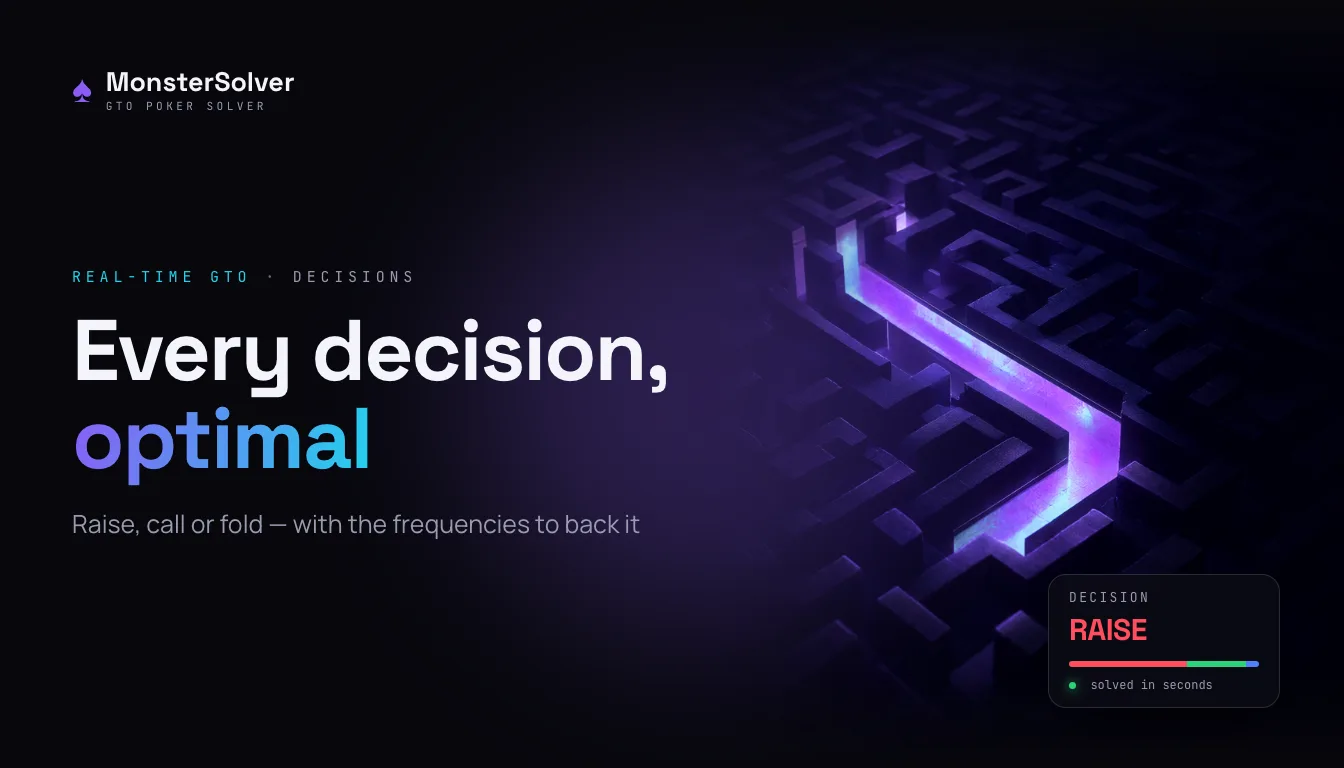
MonsterSolver is a state-of-the-art GTO poker software — a No-Limit Hold'em solver running a neural solving engine on cloud GPUs. It sees a spot the way you see it: exact hand, exact board, exact stacks, any action history, 2 to 6 players. You ask; it answers in seconds — a complete range grid with action frequencies and EV for every line. Not a verdict. A workbook: which hands bet, which check, which fold, and what each line is worth, so you can see the reason, not just the action.
The co-pilot's specs, at normal-player prices:
- Nothing to operate. No tree building, no Java flags, no 64–128GB of RAM. The compute lives in a data center, not your basement.
- No license fee. A small prepaid balance, pay only for what you solve, free credits at signup.
- No plumbing. It reads the table itself — this RTA poker software works with virtually every client, no per-room plugins, no hand-history files. It sees what you see, on whatever site you sit at.
- The full table. Preflop and postflop, any board, any sizing, 2 to 6 players — the HU flop through the six-handed monster.
Their about page says it best: "fast, affordable and available to everyone — not just pros with a server rack in the basement."
A co-pilot has to be worth trusting
A co-pilot you don't trust is just noise, so here's the pilot's rating, in one breath:
Poker was the last game the engineers thought machines couldn't crack — a game tree of roughly 10¹⁶⁰ reachable states, against chess's 10⁴⁷ (chess fell in 1997, Deep Blue versus Kasparov). 2015, UMass mathematicians solve Limit Hold'em — proof poker is a solvable game. 2017, Libratus (Carnegie Mellon) beats a world champion heads-up No-Limit. 2019, Pluribus (Facebook) plays six-max against four of the world's best human players — four on one — and wins the majority of the hands. The table shape you play. Seven years of untouchable research — then a billing page.
One honest line, because trust is built on it: nobody printed the complete strategy for No-Limit Hold'em — 10¹⁶⁰ states means that's not happening. Chess was never "solved" either — it was cracked. The day amateur-runnable analysis arrived, the best human in the world quietly became the second-best player in the room; nobody needed the complete solution, just the answer key for the position in front of them. That's what the co-pilot returns — and the approximations are already strong enough that no human plays closer to equilibrium than the software.
What the human-plus-machine team actually does
The human drives. Every decision at the table is yours, made with your hands and your nerves and your reads. The co-pilot never clicks. That's not a limitation — that's the product. A poker career is built on decisions you own, and the moment the machine owns them, the career is a ban.
The co-pilot grades. After the decision — in play-money drills, in the session review, on stream — the answer lands in seconds: your line versus the GTO-optimal line, with the EV of each. Not "did I win?" (noise) but "was the decision right?" (signal). The human-plus-machine team gets the feedback loop that used to take a decade of expensive losses, compressed into a coffee.
The human internalizes. The range grid shows the why — range advantage, nut advantage, board texture, stack-to-pot ratio — so the patterns install into your brain. The next session, the right line feels obvious, and now it is. The co-pilot's job is to make the human's instinct solver-grade, session by session, until the co-pilot is mostly a check.
The team streams. The most honest content in poker: the decision, then the solve, then the gap. Let your chat watch the best move appear on screen — the way televised poker commentary calls the "right" play. The audience gets the analysis; the table stays honest. (And if you create content, coaches and creators take a 30% referral share — this article is its own business model.)
Why the other tools can't be a co-pilot
A co-pilot has to see your spot, your numbers, fast. Test the field against that:
- Charts are a map of someone else's country. Your stacks, your board, your opponents' actual action line — a chart can't see them.
- Pre-solved libraries (GTO Wizard-style) are a co-pilot that only knows the routes it was pre-loaded with — their spots at their sizings and their rake. Change the stack depth or bet size and it's confidently lost.
- Desktop solvers (PioSolver, MonkerSolver) know every route — the gold standard for your exact tree — but they're a cargo cult: build the tree, pick abstractions, wait hours for convergence, on RAM you have to buy first. A co-pilot that answers next weekend isn't a co-pilot.
MonsterSolver is the only one that sees your spot, your numbers, and answers in seconds: type the spot, get the answer, done.
The one thing the co-pilot refuses to do (and why that's the feature)
Full transparency, because a co-pilot has to be honest about its capabilities: MonsterSolver is RTA-capable. It reads the table on virtually every popular poker site and returns an answer in 1–5 seconds to each situation — it could run live, in real-money games, and click for you.
It shouldn't, and we don't recommend it. It's not fair — no opponent at your table has a co-pilot, and MonsterSolver's own fair-use policy says study and training only, never real-time assistance in real-money play. And it's non-human — that's the tell. You might never get caught, but use it often and you'll always win, and a consistent, humanly-impossible win rate is exactly what detection teams look for. When they do flag you, the penalty at every legitimate room is the same: permanent closure, fund seizure, blacklist. Don't be the case study.
The co-pilot that grades you makes you a better driver. The autopilot that drives for you makes you a defendant. Same software, two different careers.
The math
The old way to get a co-pilot was a stack: a $249–$1,100 license, a machine upgrade, a learning curve in weeks. The new way is a small balance of prepaid credits — pay only for what you solve, free credits at signup. One real leak found in week one pays for the lifetime.
The best player at the table
The best player at the table is no longer the one with the best instinct, or the biggest database, or the most hours. It's the human who drives — and has the engine grading every line, in seconds, on the exact spot.
That's you. The co-pilot is ready.
The only question left is which side of the board you're on.